Compliance & Standards
A pool fence is the one part of your backyard with a law attached. Here’s what the rules actually require, and where people come unstuck.
AS1926.1 - the standard behind every pool barrier
AS/NZS 1926.1 is the Australian Standard for swimming pool safety barriers. Every state and territory adopts it through its own building legislation, which is why the fundamentals are consistent nationally while the paperwork around them differs by state.
Pool Perf® panels are manufactured to that standard and have been independently tested in a NATA-accredited laboratory - test report AZT0434.19, which we can provide on request. Every panel forms part of the Perf Safe® certified system.
But here is the part worth being blunt about: a compliant panel does not automatically make a compliant barrier. Compliance is a property of the whole installation - heights, ground clearance, gate hardware, and what happens to sit near the fence. That is why the installer matters as much as the product.
The fundamentals
- 1200mm minimum barrier height
- 100mm maximum gap under the barrier
- 100mm maximum gap between vertical members
- 1200mm radius non-climbable zone arc
- Gates self-closing and self-latching, swinging away from the pool
- Latch release out of a child’s reach
The non-climbable zone catches most people
More barriers fail on this than on anything else - and usually because of something that was added after the fence went up.
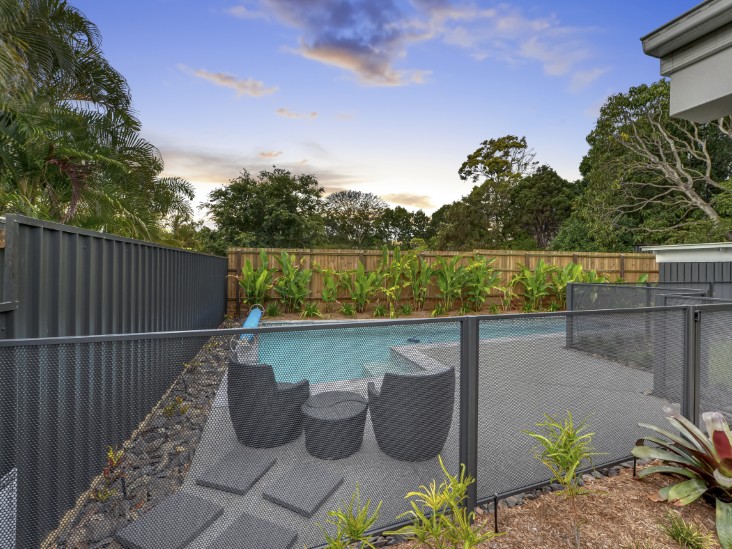
The non-climbable zone is measured as an arc with a 1200mm radius. Anything inside that arc that a child could stand on turns a compliant fence into a non-compliant one. Common culprits:
Sloping ground is the other one. Where the land falls away, panels have to be raked or stepped so that both the barrier height and the arc stay satisfied at every point along the run. Getting that right is measuring work, done on site, before anything is manufactured.
What applies in your state
The 1200mm barrier and the non-climbable zone are national. The registration, certification and inspection requirements are not.
New South Wales
Pools must be registered on the NSW Swimming Pool Register, and a valid certificate of compliance (or occupation certificate) is required before a property is sold or leased. Barriers are inspected against AS1926.1 as adopted by the Swimming Pools Act.
Queensland
Pools are recorded on the state pool register and require a pool safety certificate, issued by a licensed pool safety inspector, when a property is sold or leased. Queensland applies AS1926.1 through the Queensland Development Code pool safety standard.
Victoria
Pool and spa barriers must be registered with the local council, and owners are required to have the barrier inspected and a certificate of barrier compliance lodged on a recurring cycle set by the regulations.
Western Australia
Local governments are required to inspect pool barriers periodically - typically on a four-yearly cycle - and the barrier must comply with the standard adopted under the Building Regulations.
South Australia
Pool barriers are regulated through the state’s planning and development legislation, with requirements applying from the time the pool is approved and built.
Tasmania, ACT & NT
Each applies AS1926.1 through its own building legislation, with local variations in inspection and certification requirements.
Compliance questions, answered
Why this argues for a professional install
None of the above is beyond an experienced person. But all of it has to be right at the same time, on your particular site, and the consequences of getting it wrong land on you as the pool owner.
A Pool Perf® Trade Partner is a licensed local fencing or glass business that installs these barriers constantly. They measure the fall, work out the raked panels, set the gate hardware, keep the non-climbable zone clear, and hand you a finished barrier built to the standard - with the product documentation to match.
Find your local Trade Partner →
Want certainty rather than a best guess?
Send through your project and we’ll connect you with the accredited installer for your area.
Talk it through with a Pool Perf® specialist
Thirty minutes on the phone, free, no obligation. Sizes, compliance, gates, colours - and which accredited Trade Partner covers your area. Pick a day and time that suits you.
Get Your Buyers Guide Now
- Current pricing, plainly set out
- The full design and colour range
- Channel Fit vs Bracket Fit, compared
- Measuring, gates and compliance